
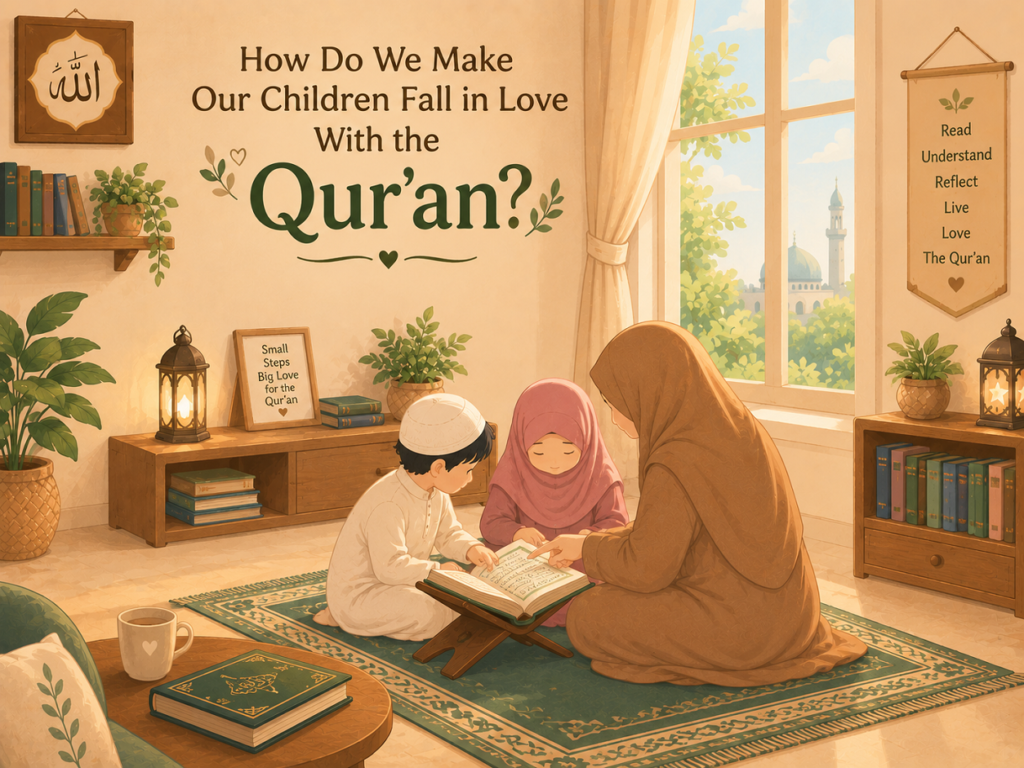
“My child doesn’t want to read Qur’an.”
Perhaps you have heard these words in your home.
You remind them.
You encourage them.
You sit beside them.
You try different ways.
Sometimes they listen.
Sometimes they get distracted.
And sometimes they simply say:
“I don’t want to.” 🥺
For parents, grandparents and teachers, this can feel frustrating.
But perhaps the question isn’t only:
“How can I make my child read more Qur’an?”
Perhaps we should ask:
“How can I help my child fall in love with the Qur’an?”
Because children don’t learn only through instructions. They learn through love, repetition, connection, example and experience.
Our goal is not simply to teach children to read the Qur’an.
It is to help them develop a lifelong relationship with the Book of Allah.
Every Child Learns Differently
Every child is unique.
One child may happily sit and read.
Another may struggle to concentrate.
One may enjoy memorising.
Another may learn better through stories.
One may love listening to recitation.
Another may understand best through activities and conversations.
This doesn’t mean one child is better than another.
So try not to say:
“Look at your brother. He can read Qur’an. Why can’t you?”
Or:
“Your sister has already memorised this. You should be able to do it too.”
Comparison can make a child associate Qur’an with pressure, competition or feeling that they aren’t good enough.
Instead, encourage their individual journey.
Say:
“MashaAllah, you’re learning. Let’s keep practising together.”
Our children don’t have to reach every milestone at the same time.
They need patience, encouragement and someone who believes in them.
Start With Allah Before the Rules
Before teaching children how much Qur’an they should read, help them understand Who Allah is.
Tell them:
“Allah created you.”
“Allah hears your duas.”
“Allah knows when you are happy and when you are sad.”
“Allah gave you your family, your food, your eyes and everything around you.”
“You can always turn to Allah.”
Then explain:
“The Qur’an is Allah’s Book. It teaches us how to live and brings us closer to Him.”
Now Qur’an is not simply something a parent says:
“You have to read this.”
It becomes:
“These are the beautiful words Allah has given us for guidance.” 🤍
When children begin to know and love Allah, their relationship with His Book can grow naturally alongside that love.
Keep Qur’an Time Small and Consistent
If a child already struggles with Qur’an, don’t begin with:
“Sit here and read for 30 minutes.”
That may feel overwhelming.
Instead, start small.
Try a five-minute Qur’an moment.
It could be:
🌙 One ayah
📖 One short surah
🎧 Five minutes of listening
💬 One simple conversation
✍️ One ayah to write
🤲 One dua connected to what they learned
Five peaceful minutes can be a beautiful beginning.
Over time, those small moments can become a familiar part of their day.
Consistency matters more than making every session long.
Make Qur’an Learning Engaging
Children naturally learn through curiosity and play.
That doesn’t mean we turn the Qur’an into entertainment.
It means we use age-appropriate ways to help children connect with its lessons.
Try:
- Qur’an-themed colouring pages
- Simple Islamic puzzles
- Stories of the Prophets mentioned in the Qur’an
- Listening to beautiful recitation
- Writing a favourite ayah
- Planting something while discussing Allah’s creation
- Talking about the lesson of a short surah
- Creating a simple learning chart
- Letting children choose which short surah to practise
The activity is not the goal.
The connection is the goal.
Let Children See You Loving the Qur’an
One of the most powerful ways children learn is by watching the adults around them.
Let them see you open the Qur’an.
Let them hear you recite.
Let them see you reflect.
Let them notice that Qur’an is part of your life, not just something you ask them to do.
Children may forget many instructions.
But they often remember what they repeatedly see.
If they see their parents turning to the Qur’an for guidance, they begin to understand:
“The Qur’an matters in our home.”
If they see peaceful recitation, they may learn:
“The Qur’an brings peace.”
If they see their parents trying to live by its teachings, they learn:
“The Qur’an isn’t only something we read. It is something we live.”
Create a Simple Qur’an Routine
Children often feel more comfortable when they know what to expect.
You don’t need a complicated schedule.
For example:
Our 10-Minute Qur’an Time 🌙
1 minute: Bismillah and settle down
3 minutes: Recitation
2 minutes: Repeat a short ayah or surah
2 minutes: Talk about its simple meaning
2 minutes: Ask:
“What can we do differently today because of what we learned?”
Keep it flexible according to the child’s age and ability.
The purpose isn’t to create another stressful timetable.
It’s to create a beautiful rhythm.
Teach the Meaning, Not Only the Words
Memorising Qur’an is a wonderful achievement.
But whenever children are old enough to understand, also introduce simple meanings.
After learning an ayah, ask:
“What is Allah teaching us here?”
“What did you understand?”
“Which part did you like?”
“How can we practise this today?”
You don’t need complicated explanations.
One simple lesson can be enough.
For example:
If the lesson is about gratitude, ask:
“What is one thing we can thank Allah for today?”
If the lesson is about kindness:
“Who can we be kind to today?”
Now the Qur’an moves from the page into everyday life.
When Your Child Is Upset, Connect Them to Allah
Children experience big emotions.
A small disappointment can feel enormous to them.
When your child is crying or frustrated, instead of immediately correcting everything, sometimes begin with:
“I know you’re upset. Come and tell me what happened.”
Comfort first.
Then gently teach:
“When your heart feels heavy, you can talk to Allah.”
Teach a very simple dua:
“Ya Allah, help me.”
That’s enough for a beginning.
Over time, children can learn:
When I am happy, I turn to Allah.
When I am sad, I turn to Allah.
When I am scared, I turn to Allah.
When I need help, I turn to Allah.
That is the beginning of a beautiful relationship with their Creator.
Don’t Expect Every Child to Follow the Same Path
Make the Home a Place Where Qur’an Belongs
Children shouldn’t experience Qur’an only during:
- Madrasa
- Islamic classes
- Homework
- Memorisation tests
Let Qur’an naturally become part of family life.
You can:
📖 Read together after Maghrib.
🎧 Listen during a quiet family moment.
🤲 Make dua together.
💬 Discuss one ayah at the dinner table.
🌙 Have a family Qur’an evening once a week.
👨👩👧 Let everyone participate according to their ability.
Even ten peaceful minutes can make a difference.
The home itself becomes part of the child’s Islamic education.
What Parents Can Do Every Day
You don’t need to completely change your family’s routine.
Start with a few simple habits:
Read Qur’an where your children can see you.
Keep Qur’an accessible
Talk about Allah naturally throughout the day.
Connect Qur’anic lessons to everyday situations
Praise effort, not only achievement.
Avoid comparing siblings.
Listen to your child’s questions.
Keep learning sessions age-appropriate.
Let children hear beautiful recitation.
Make dua for their relationship with the Qur’an.
Small habits repeated with love can leave a lasting impression.
Remember What We Are Really Building
Our goal is not simply:
“My child finished this many pages.”
It is not only:
“My child memorised this many surahs.”
Those accomplishments are beautiful, but there is something deeper.
We want our children to grow up knowing:
The Qur’an is guidance.
The Qur’an teaches me how to live.
The Qur’an brings me back to Allah.
The Qur’an is something I can turn to throughout my life.
That is the relationship we hope to nurture.
We Plant the Seeds
Your child may not understand today why the Qur’an is precious.
That’s okay.
Keep introducing it with love.
Keep reciting.
Keep listening.
Keep talking about its lessons.
Keep answering questions.
Keep creating a peaceful environment.
Keep making dua.
Parenting isn’t about controlling every outcome.
It is about guiding, nurturing and planting beautiful seeds.
And then we place our trust in Allah.
Because seeds don’t become trees overnight.
A Dua for Our Children
Ya Allah, place the love of You and Your Qur’an deep within our children’s hearts.
Make the Qur’an a source of guidance, comfort and light for them.
Give parents wisdom, patience and gentleness when teaching their children.
Help us teach Your Book with sincerity and beautiful character.
Make our children among those who recite the Qur’an, understand its guidance, live by its teachings and carry its light throughout their lives.
Ameen Ya Rabbal Aalameen.
Help Your Child Discover Islamic Learning
At Prophetic Tales, we believe children can learn about Islam through stories, meaningful conversations, simple activities and gentle reflection.
Our resources are created to help children explore their faith in an age-appropriate and engaging way—so Islamic learning can become something they enjoy discovering with their families.
Explore Our Islamic Books & Learning Resources
→ Explore Islamic Books for Kids
→ Explore Islamic Learning Resources